← 01 · MISSIONS LN‑SYS · MISSION BRIEF 03
MISSION 03 · CASE STUDY

Event Lead Intelligence

Post-event follow-up, industrialized — AI research agents that turn booth scans into rep-ready briefs, and the live workspace reps actually work them in. Every scan researched before the team's flight lands.

150+
research agents running in parallel — one per lead, not one per hour
1,000+
rep-ready briefs across two shows — person, company, context, opener
1
workspace where the follow-up actually happens — briefed, assigned, worked to done
01 · THE PROBLEM

Every badge scan is a promise somebody forgets.

The booth does its job: hundreds of scans, real conversations, warm intent. Then the event ends and the scans land in a CSV — where the warmth goes to die. Follow-up trickles out weeks later, generic and cold, written by reps who can't possibly research a thousand strangers by hand.

The math never worked: fifteen minutes of research per lead times a thousand leads is a quarter of a work-year. So the research simply didn't happen.

02 · THE CALL

Why agents, and why briefs.

The decisions that shaped the system:

WHY AGENTS?
Research parallelizes perfectly and humans don't. 150+ agents run the fifteen minutes simultaneously — the quarter-work-year collapses into the time of one coffee.
WHY BRIEFS, NOT SCORES?
A score tells a rep whether to call. A brief tells them what to say — who the person is, what the company's doing, why the conversation at the booth mattered, and an opener that proves someone paid attention.
WHY A WORKSPACE?
Intel that lives in email attachments dies there. The briefs land in the same live workspace the follow-up is worked in — assigned, statused, done.
03 · THE ARCHITECTURE

From a thousand scans to a worked queue.

Scan export in; an agent fleet researching, enriching, and composing in parallel; briefs landing in a Redis-backed workspace where reps pick up, work, and close the loop.

BADGE SCANS booth + sessions 3 days · every scan AGENT FLEET research · enrich · compose ONE AGENT PER LEAD 150+ parallel fails alone · retries alone BRIEFS rep-ready cited context WORKED assigned acted · done
THE FAN-OUT — every scan gets its own agentTHE CONVERGENCE — briefs land in one live queueTHE CLOSE — a queue that actually ends
04 · THE BUILD

What it's made of. What it talks to.

Next.js + TypeScript, a parallel agent pipeline on Claude, Redis-backed live state, deployed on Vercel.

THE FLEET PATTERN
One agent per lead, not one prompt per batch — each brief gets a full research pass, and a bad lead can't poison its neighbors. Failures retry alone.
CODE MOMENT · the fleet fan-outREPRESENTATIVE — PRODUCTION PATTERN, RECONSTRUCTED
// One agent per lead — a bad lead can't poison its neighbors, and failures retry alone.
const queue = [...scans];                          // every scan from 3 days, not the top 50
const workers = Array.from({ length: CONCURRENCY }, async () => {
  while (queue.length) {
    const lead = queue.pop()!;
    try {
      const research = await agent.research(lead);     // company, role, why-now — with citations
      const brief    = await agent.compose(lead, research);
      await redis.hset(`brief:${lead.email}`, brief); // lands in the live workspace
    } catch (err) {
      await retries.push({ lead, attempt: att(lead) + 1 }); // alone, capped, logged
    }
  }
});
await Promise.all(workers);
Why this moment: the naive version is one prompt over a spreadsheet — cheap, shallow, and one malformed row ruins the batch. The fleet shape is what makes "every scan researched before the flight home" possible.
05 · THE SCREENS

From scan to worked lead.

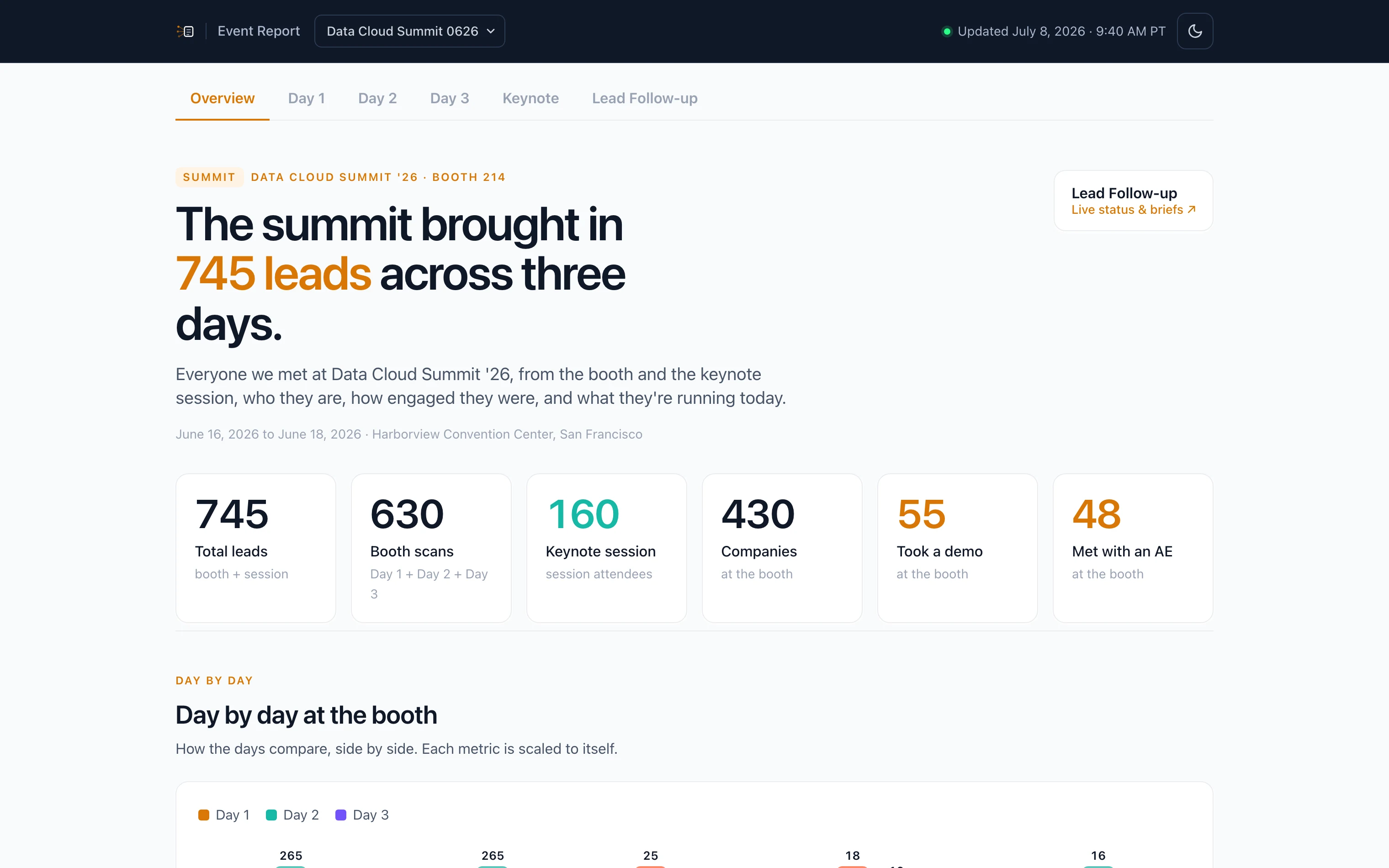
Captures from the working demo — a rep-ready brief, the workspace queue, and the event report. A short walkthrough of one lead's journey lands here next.
THE BRIEFONE LEAD, FULLY RESEARCHED · DRAWER VIEW
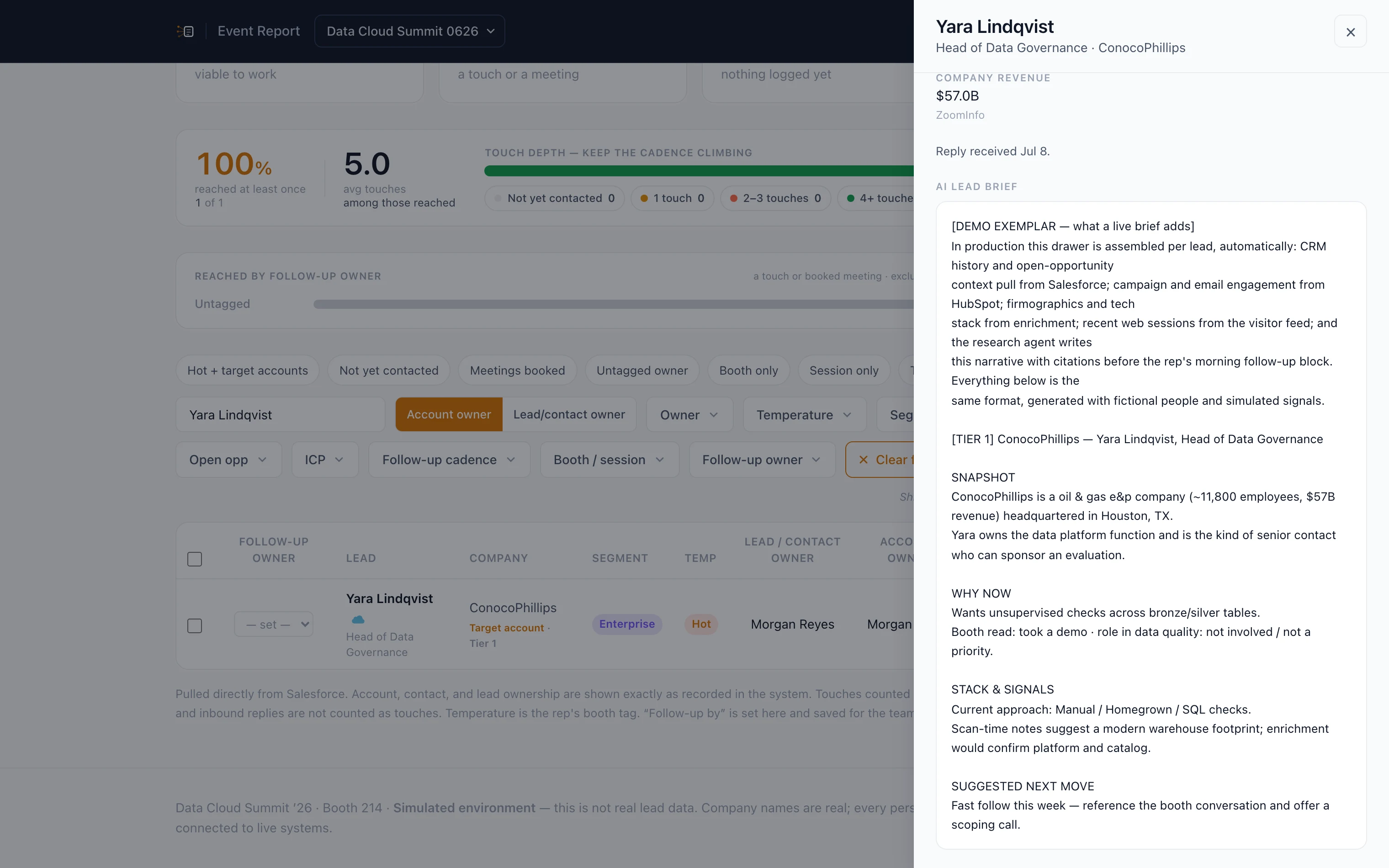
A lead drawer open on the annotated exemplar brief — snapshot, why now, stack and signals, and a suggested next move for one scanned attendee
The brief. What a rep opens the morning after — who this person is, why now, what they run, and the suggested next move. This one is the annotated exemplar explaining what a live brief adds.
THE WORKSPACEFILTERS · OWNERS · QUEUE IN MOTION
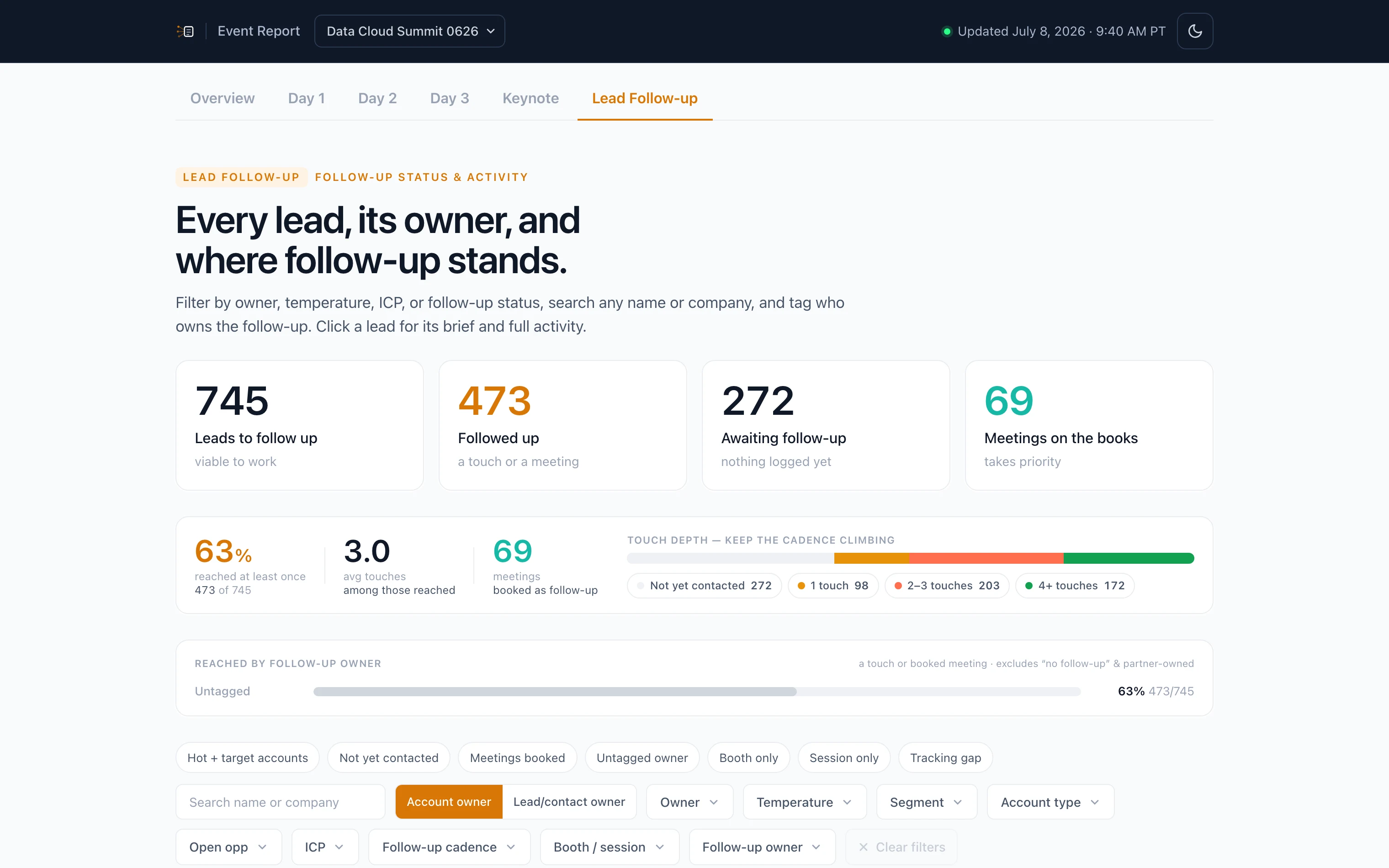
The leads workspace — searchable, filterable queue of every scanned lead with owners, temperature, touches, and meeting status
The queue. Every lead, its owner, its temperature, its last touch — filters and quick views narrow to the work that matters right now.
THE REPORTSCANS · SIGNALS · TARGET ACCOUNTS
The event report front page — scan totals, demand signals, and target-account presence across the show
The report. The show itself, readable at a glance — who came, which conversations demand action, which target accounts showed up.
WALKTHROUGH FILMREPORT → QUEUE → ONE BRIEF READ · 28S
One lead's journey. The report, the workspace narrowed to hot target accounts, then the Yara Lindqvist brief opened and read to its suggested next move.
06 · WHAT IT DELIVERS

Follow-up that lands while it matters.

Every scan researched before the flight home — not the top fifty, all of them. Notes that read like someone was listening — because the brief remembers the booth conversation the rep can't. A queue that ends — assigned, worked, done; no CSV graveyard.

07 · LIVE DEMO

Read the briefs yourself.

The full working shell on synthetic event data — the queue, the briefs, the board. Access is by code (it rotates per conversation — if we're talking, you have one; if not, transmit and I'll send it).

ENTER ACCESS CODE →

LIVE DEMO · ACCESS IS CODE-GATED