← 01 · MISSIONS LN‑SYS · MISSION BRIEF 02
MISSION 02 · CASE STUDY

Pipeline Pulse

The weekly pipeline review, rebuilt — from a hand-made slide deck into a web app on scheduled Salesforce pulls. Open the link and the numbers are already there: every deal, every movement, every section drawn from the source on schedule — never assembled by hand.

Fresh
scheduled pulls straight from Salesforce — zero exports, zero copy-paste, zero hand-built decks
12
report sections in one continuous review — pipeline, movement, sources, forecast
0 decks
replaces the weekly slide ritual entirely — the link is the meeting
01 · THE PROBLEM

The Monday deck was stale by Sunday.

The weekly pipeline review ran on a slide deck assembled by hand: export the report, paste the numbers, screenshot the charts, fix the fonts, ship it. Hours of assembly for a snapshot that was already wrong by the time leadership saw it.

Worse than slow: silent. Hand-carried numbers hide their errors — a missed filter or a stale export ships with full confidence, and decisions get made on it.

02 · THE CALL

Why fresh data, and why an app.

The decisions that shaped the system:

WHY PULLED, NOT PASTED?
Staleness is the whole disease. Pulling straight from Salesforce on a schedule means errors surface at the source — where they can be fixed — instead of shipping in a deck.
WHY NOT A BI DASHBOARD?
The weekly review is a narrative, not an exploration. A purpose-built app walks leadership through the same questions in the same order, every week — no dashboard sprawl, no filter roulette.
WHY GATED?
Pipeline is sensitive. A login in front of revenue data isn't a nice-to-have — and building the gate is part of the demonstration.
03 · THE ARCHITECTURE

From the source to the screen.

Scheduled SOQL against the systems of record; a shaping layer that turns raw records into the review’s sections; a gated Next.js app that renders them the moment they're asked for.

SALESFORCE soql · on schedule SHAPING RULES stage math · deltas source attribution THE REPORT review sections one narrative order ACCESS GATE code · 24h session THE REVIEW leadership ritual no exports · no paste · the number on screen is the number in the system
FRESH — pulled on schedule, never hand-copiedSHAPED — rules, not hand-editingGATED — revenue data behind a code
04 · THE BUILD

What it's made of. What it talks to.

Next.js + TypeScript, scheduled SOQL data layer, session-gated access, deployed on Vercel.

THE DATA CONTRACT
Every section declares the exact SOQL it runs — the review can always answer "where did this number come from?" with a query, not a shrug.
CODE MOMENT · movement deltasREPRESENTATIVE — PRODUCTION LOGIC, RECONSTRUCTED
// Week-over-week movement is math on two matched pulls — never memory, never a copy.
const prior = await soql(SNAPSHOT_QUERY, { asOf: lastReview });  // same query, matched window
const now   = await soql(SNAPSHOT_QUERY, { asOf: today });

const moved     = now.filter(o => prior.byId[o.Id] && prior.byId[o.Id].StageName !== o.StageName);
const generated = now.filter(o => !prior.byId[o.Id] && stageRank(o) >= STAGE_2);
const slipped   = moved.filter(o => stageRank(o) < stageRank(prior.byId[o.Id]));

// Every section ships with its own query — "where did this number come from?"
// is always answerable by running it.
export const section = { rows: moved, query: SNAPSHOT_QUERY, window: [lastReview, today] };
Why this moment: the review's credibility rests on this shape — cumulative numbers are re-pulled from source each cycle, comparisons use matched windows, and every figure keeps a pointer to the exact query that produced it.
05 · THE SCREENS

The review itself.

Captures from the working demo — the open, the goal tracker, and the health section's deal cards. A short walkthrough of a full review lands here next.
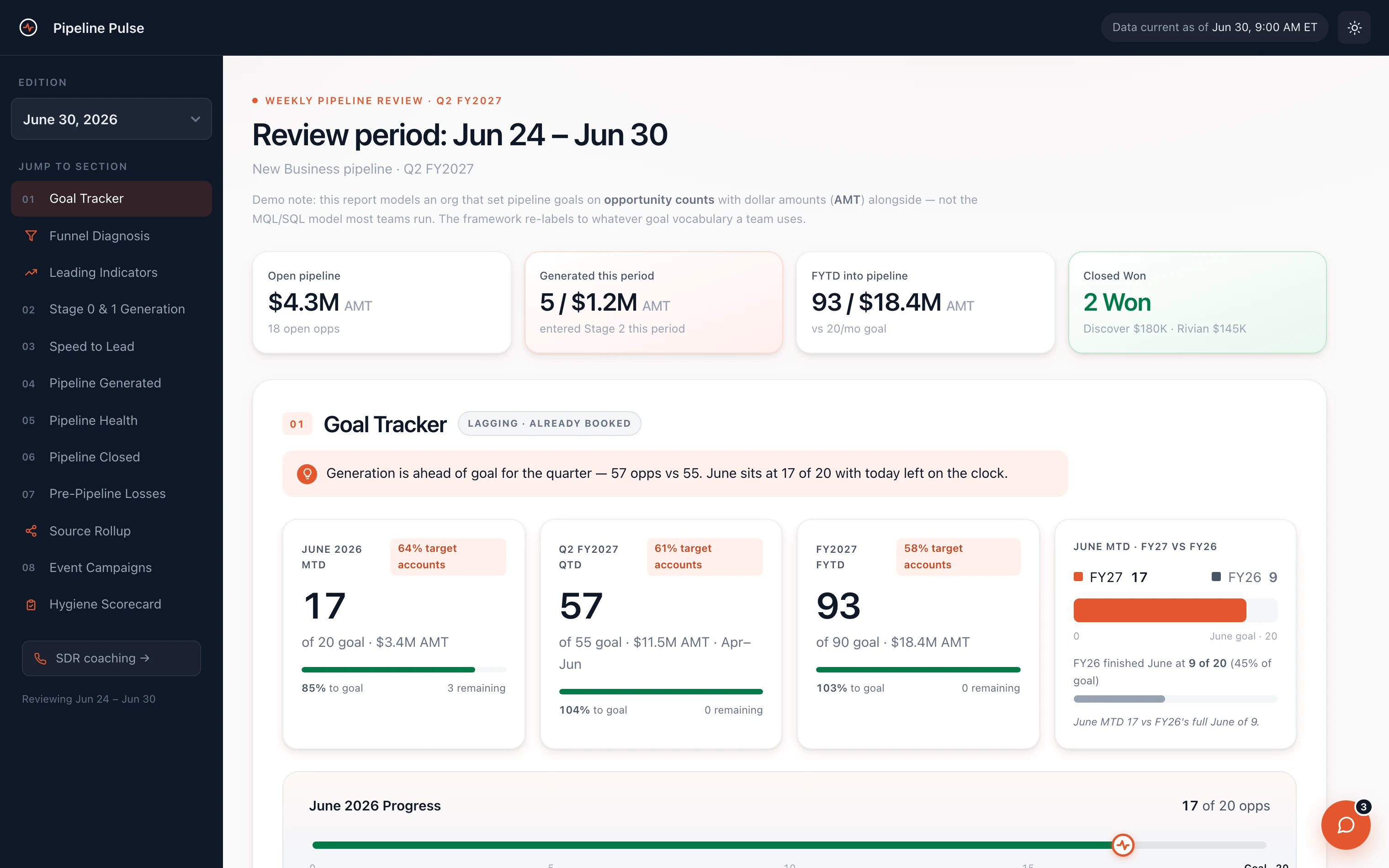
PIPELINE PULSE · THE OPENREVIEW PERIOD JUN 24–30 · REPORT HEADER
The review's opening screen — review period, headline chips for open pipeline, generated this period, FYTD, and closed won, with the goal tracker beginning below
The open. The review starts answering before anyone scrolls — open pipeline, what was generated this period, pace against goal, and the wins, all in the first screen.
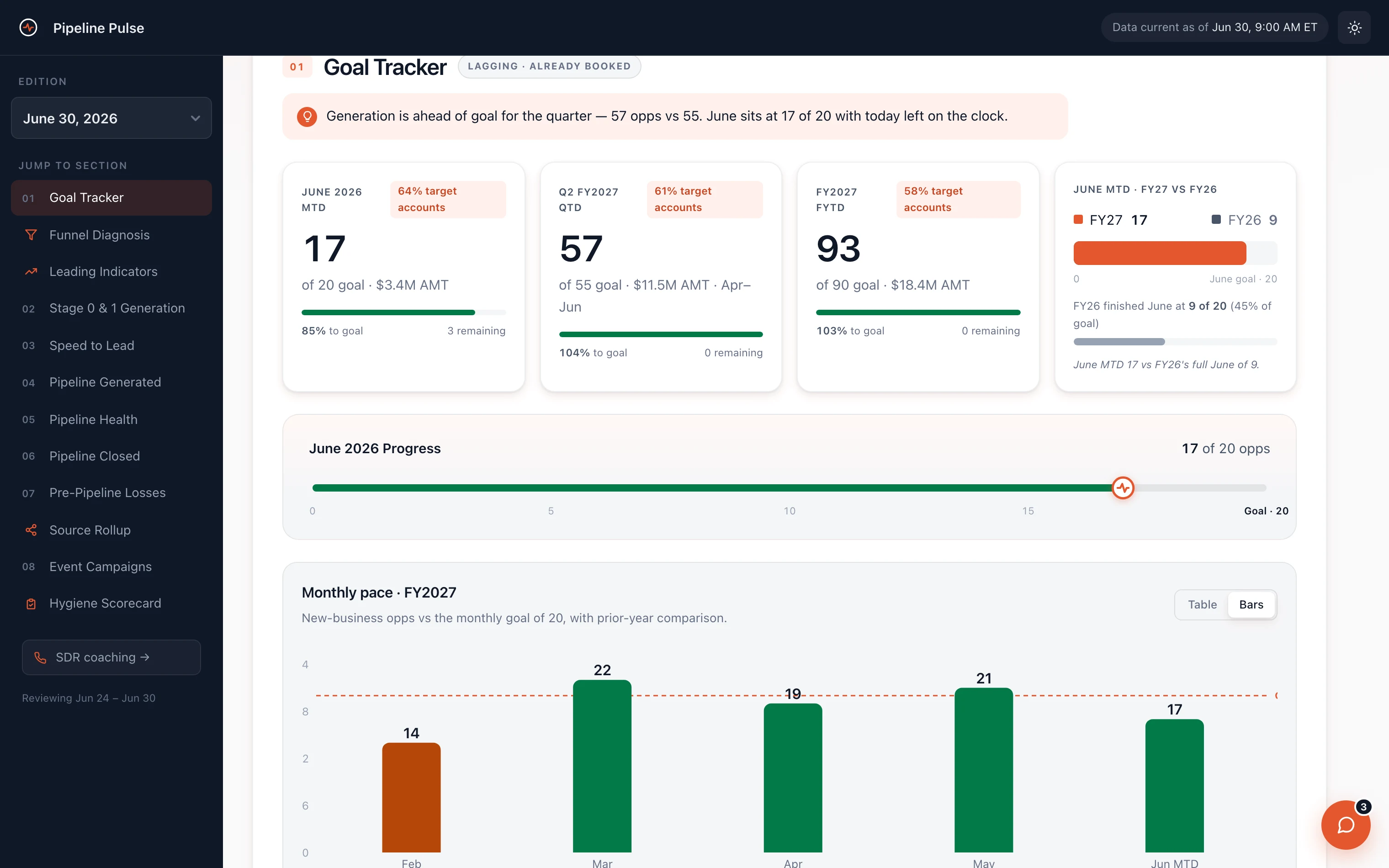
GOAL TRACKER57 OF 55 QTD · ZONED PACING
The goal tracker — MTD, QTD, and FYTD pacing cards with target-account rates, a progress slider, and monthly pace bars against the goal line
The pace. Month, quarter, and year on one row — each horizon zoned against its goal, with prior-year context so "ahead" means something.
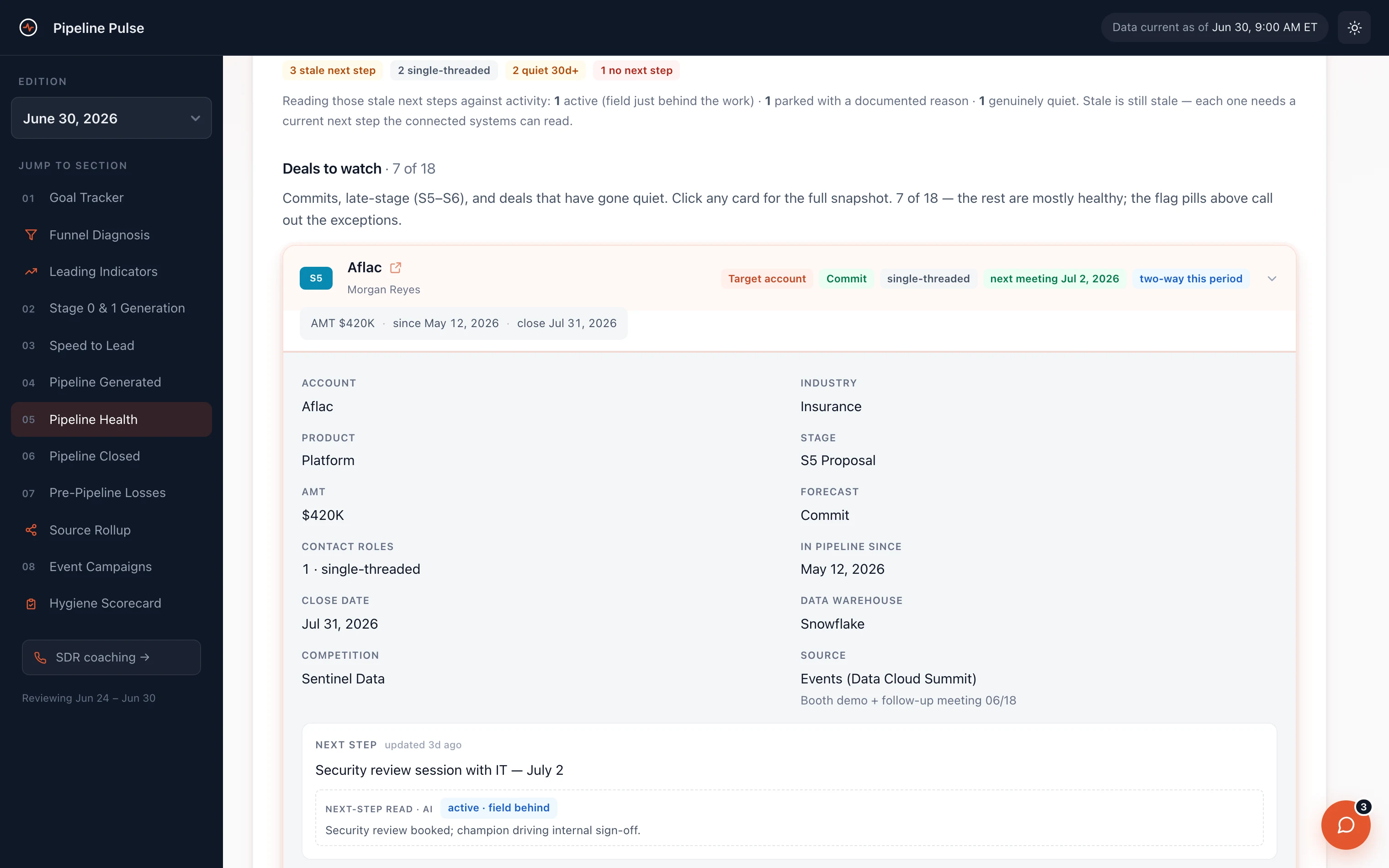
PIPELINE HEALTHFLAGS · DEALS TO WATCH
The pipeline health section — hygiene flags across the book and expandable deal cards carrying commit, threading, and meeting flags per opportunity
The stories. Hygiene flags read against activity, then a card per deal that matters — commit status, threading, next meeting — each expandable to its full snapshot.
WALKTHROUGH FILMTHE WEEKLY REVIEW, END TO END · 33S
The ritual, in one pass. Open the link, walk the sections — pace, funnel, speed-to-lead, a deal card opened mid-flight, the wins — and end on the methodology.
06 · WHAT IT DELIVERS

The meeting, minus the assembly.

Decisions on current truth — the number on screen is the number in Salesforce as of the last pull, not last month’s deck. Errors surface before the meeting — bad data shows up as bad data, not as a confident slide. The ritual collapses to a link — no exports, no paste, no deck; the hours come back every single week.

07 · LIVE DEMO

Run the review yourself.

The full working shell on synthetic pipeline data — every section, every deal card, every movement view. Access is by code (it rotates per conversation — if we're talking, you have one; if not, transmit and I'll send it).

ENTER ACCESS CODE →

LIVE DEMO · ACCESS IS CODE-GATED